PrepPals is a simple web-based tracker that helps college roommates and friend groups coordinate weekly meal prep and split costs fairly. The site focuses on three main tasks: planning shared meals, tracking ingredients and total cost, and splitting that cost evenly among all group members.
Users can create or join a “meal group” (for example, “Apartment 304”) and add meals to a weekly plan, such as “Monday Dinner – Stir-Fry” or “Thursday Lunch – Pasta Bake.” For each meal, they can enter ingredients, estimated cost, and who is responsible for cooking. The site then calculates the total grocery cost for the week and how much each person owes.
The primary goal of PrepPals is to reduce the friction around shared cooking: fewer duplicated groceries, fewer last-minute questions about what to eat, and a clearer understanding of cost sharing in a college household.
The primary audience is college students who live with roommates or close friends and want to cook together to save money and eat more regularly. These users are busy, budget-conscious, and juggling classes, clubs, and part-time jobs. They need a tool that is simple, fast to update, and easy to understand at a glance.
A secondary audience is any small household or pair, such as partners or young professionals, who share grocery shopping and cooking responsibilities. For them, the same features—meal planning, ingredient tracking, and cost splitting—are still useful, even outside a college context.
Because the audience is already familiar with digital tools, the interface should emphasize clarity and minimalism: clear headings for each week, readable lists of meals, and straightforward cost summaries (reference: Venmo Groups).
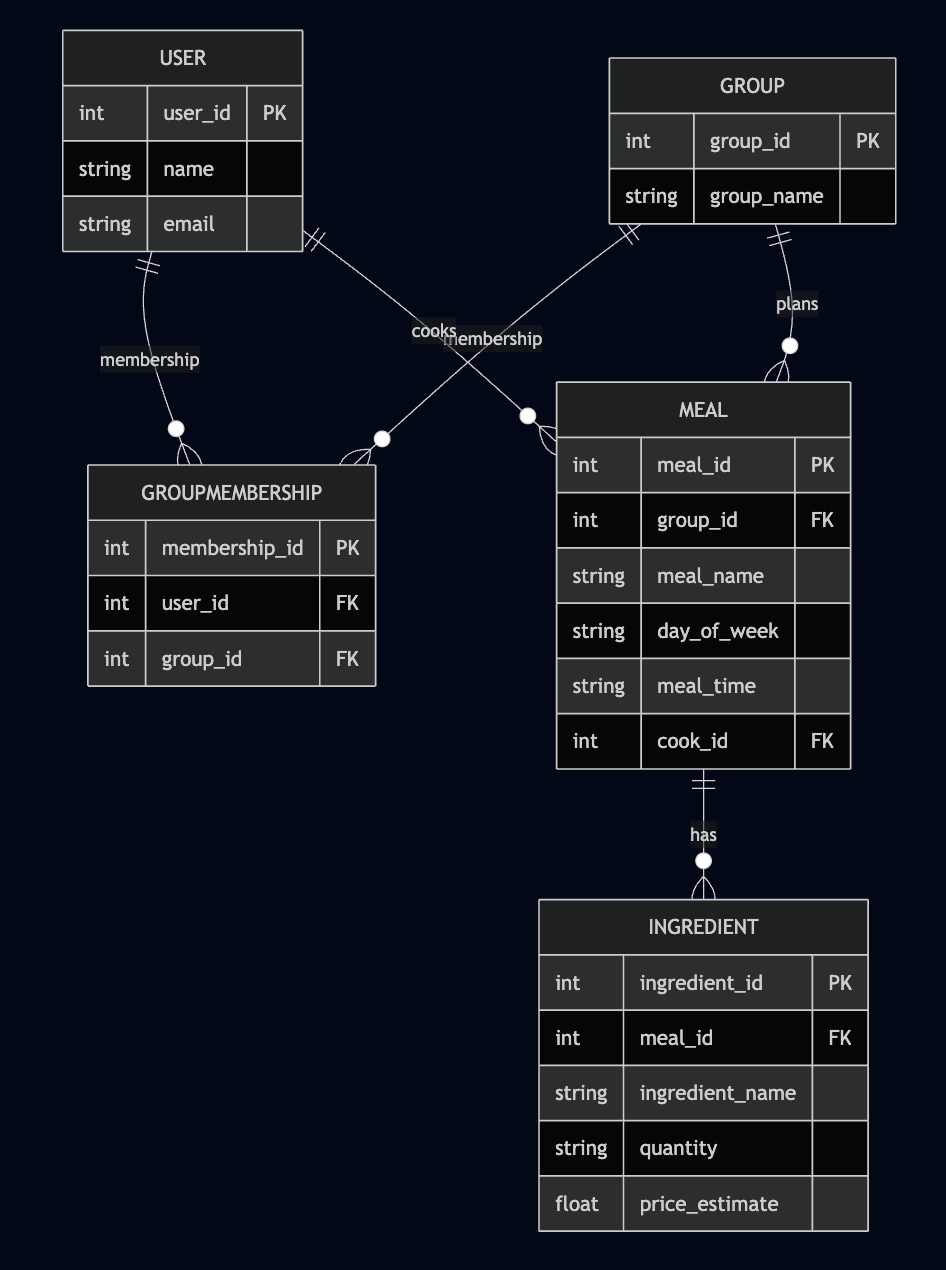
The core of PrepPals is structured around a small set of related data types: users or group members, groups, meals, and ingredients.
Users have a name and belong to a group. Groups represent a household or friend circle. Each meal belongs to a group and includes a name, a day of the week, a meal time (such as breakfast, lunch, or dinner), and an assigned cook. Ingredients belong to meals and include a name, quantity, and a price estimate for that ingredient.
From these ingredients, the site can compute the total cost of each meal and the total weekly grocery cost for a group. It can then divide that cost evenly by the number of group members or apply a simple rule where everyone pays equally.
For the purposes of the class, all data can be stored in a small, hand-created dataset such as JSON or CSV files with sample groups, meals, and realistic ingredient prices. In a richer implementation, users could enter their own meals and prices through forms, and the site would update the totals dynamically.
This dataset is well-suited for the project because it is structured, easy to understand, and directly supports visual elements like a weekly meal list and a cost summary per person.
The schema below shows how users belong to groups, meals are planned within a group, and each meal has ingredients with estimated prices.